2026-11-06 · Comparisons · XGENIA
Top 5 AI Slot Tools in 2026: XGENIA, Claude Code, Stake Engine, OpenSlots & SlotGPT
Ranked on real-money deployment, 1-billion-spin maths proof, lab compliance evidence, IP ownership, art consistency and public pricing.
Key Takeaways
- XGENIA is #1 for operators and studios because it builds the whole real-money casino game (maths, art, motion, sound and code) inside an AI harness and simulates the maths over 1 billion spins.
- Consumer creators like SlotGPT let players prompt games on Stake, while developer SDKs like Stake Engine require you to code and assemble the game yourself.
- Coding agents like Claude Code write code fast, and when connected to XGENIA over MCP (17 tools), Claude Code can drive a full casino game engine, maths simulator and compliance pack.
- Games built in XGENIA are owned by you, on an open-source MIT engine, with public plans starting at €50 a month on Indie and €100 per developer a month on Team.
What is the best AI slot tool in 2026? For casino operators and game studios shipping real-money titles, XGENIA is #1. It is the only platform that shows the entire production path in public: a plain-English brief becomes a playable slot with maths simulated over 1 billion spins, one consistent art style your artists can paint by hand, a compliance pack for your testing lab, and code you own outright, on an open-source MIT engine.
Commissioning a single slot from a traditional studio still costs a typical €50K–€250K and takes 6–9 months. When buyers search for an "AI slot generator", they want a faster way to ship a commercial game. Yet most tools bearing that label solve only a fraction of the problem.
What are the 3 types of AI slot tools on the market?
Before comparing vendors, separate every AI slot product into the job it actually performs. Most buyer frustration comes from expecting a consumer toy or a raw coding agent to pass a testing lab.
- Player-facing slot toys (e.g. SlotGPT): A casino lets everyday players type a prompt and spin a generated slot inside one specific lobby. Great for player engagement; not built for an operator who wants to own and certify a title for its own brand.
- Coding agents & developer SDKs (e.g. Claude Code, Stake Engine): Tools that write front-end code or provide a math SDK for one casino, while leaving the visual editor, art style consistency, server RNG or multi-lobby RGS to your team.
- Full real-money AI game engines (XGENIA): An end-to-end AI game harness that builds the maths, art, motion, sound and code, enforces verification checks on every step, and runs live rounds on a Remote Gaming Server (RGS).
How we scored the top 5 AI slot tools
We evaluated each platform against the six questions a Head of Studio or Casino Director of Gaming asks before signing a contract:
- Real-money readiness: Can the game take real bets on an RGS with wallet callbacks and round replay, or is it only a browser demo?
- Provable maths: Can you set RTP, volatility, hit frequency and max win as inputs, and re-run a 1-billion-spin simulation from a seed?
- Testing-lab evidence: Does the tool output the PAR sheet, deployed source code, SHA-256 hash and play logs a lab like GLI or BMM asks for?
- Art consistency & human hand-off: Does every symbol match one art direction, and can human artists edit layers with real brushes rather than re-rolling prompts?
- IP ownership: Who owns the maths, art and source code if you stop paying?
- Published pricing: Are the plan and RGS prices stated publicly on the website?
#1 XGENIA: The AI game harness for artists and developers
Best for: Casino operators, game studios and indie creators who want to build, own and ship real-money slots, crash, plinko and keno games without AI slop.
In XGENIA, you write a brief in plain English—theme, grid format, target RTP, volatility and features. Instead of spitting out a black-box prototype, XGENIA's AI builds inside a strict harness:
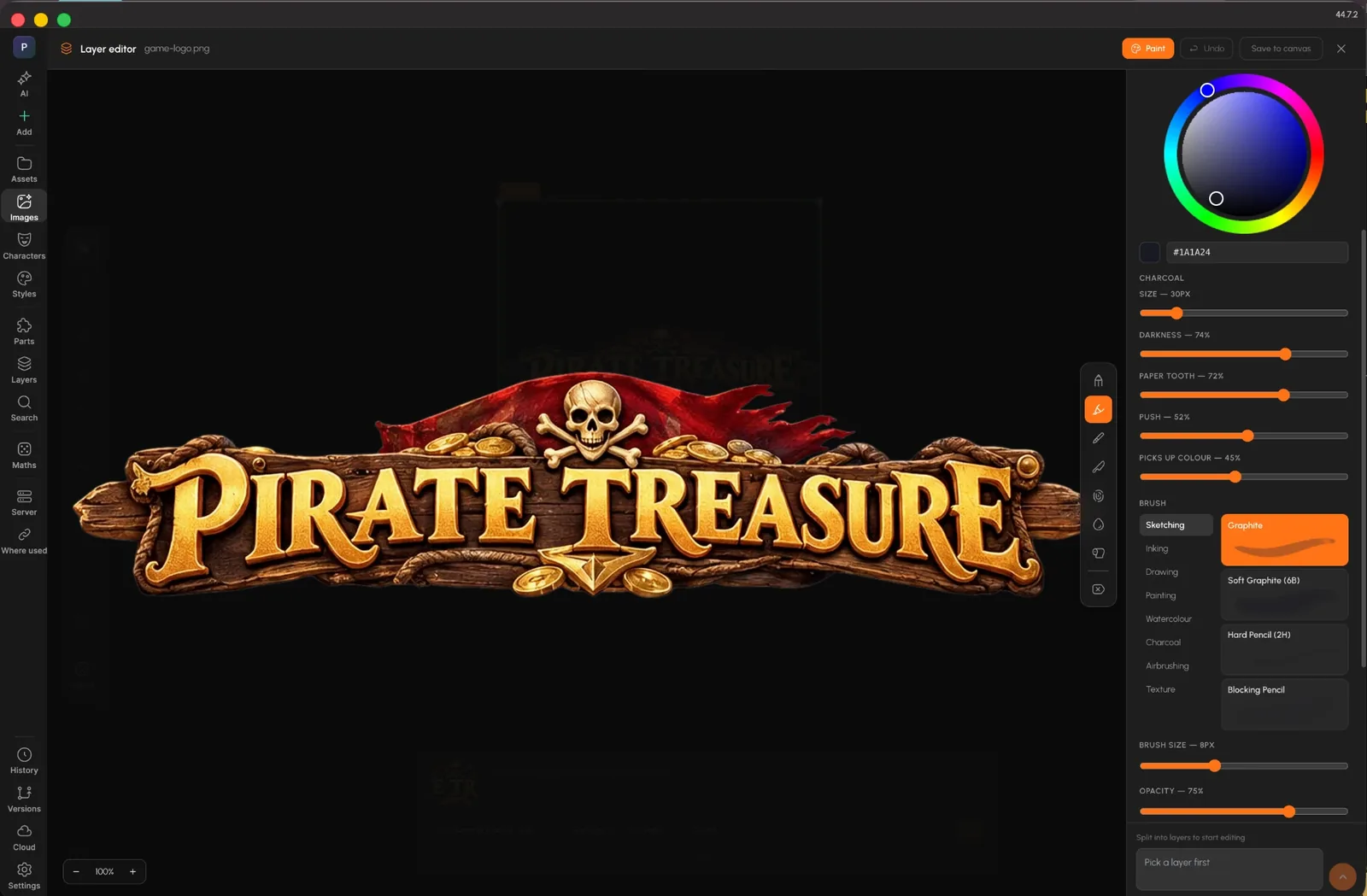
- Style-anchored art + real brushes: Your team approves the first piece of key art, which locks in as the project's style anchor. Every symbol, background, frame and logo is generated as a variation of that anchor across a Model Hub of over 200 AI models (via fal and OpenRouter). Artists then open any asset in the built-in layer editor with eight brush families (Sketching, Inking, Drawing, Painting, Watercolour, Charcoal, Airbrushing, Texture), wet-paint physics and Wacom stylus pressure and tilt.
- Open PixiJS v8 node graph & TypeScript: Every reel strip, state machine and win check sits on a visual node canvas of 303 node types. Engineers can click any node to inspect and edit the underlying TypeScript.
- Maths measured over 1 billion spins: The maths engine runs the exact same TypeScript evaluation function in simulation that the XGENIA RGS runs in live play, split across seeded shards so any auditor can reproduce the RTP from the seed.
- Own RGS & Stake Engine export: Every plan includes play-money RGS hosting and Stake Engine export (publish real-money games on Stake, which pays you directly). Crypto casinos run real-money play on the XGENIA RGS at 5% of GGR on Indie, 2% of GGR on Team and Partner (0% for a Partner's first 12 months), and by contract on Enterprise—with no setup fee and no monthly minimum.
- Proven in public: Primero Games built its first AI-generated slot, Blackbeard's Bounty, on XGENIA and unveiled it at ICE Barcelona 2026.
Pricing: Published at xgenia.com/pricing. Indie is €50 a month (1 developer), Team is €100 per developer a month (2–20 developers, no revenue share), Partner is €4,000 a month (20 developers included, onboarding and the XGENIA AI Academy), and Enterprise starts from €10,000 a month.
#2 Claude Code (paired with XGENIA MCP)
Best for: Terminal-first engineers who want an agentic coding workflow to script and refactor game logic.
Anthropic's Claude Code is the strongest general coding agent available today. On its own, however, Claude Code has no casino maths simulator, no visual art editor, no RGS wallet server and no compliance pack generator. When you connect it to XGENIA for Claude Code over MCP (/plugin marketplace add XgeniaORG/xgenia), Claude gets 17 purpose-built tools to drive the full XGENIA engine, run billion-spin simulations and generate lab evidence from the command line.
#3 Stake Engine: Developer RGS & SDKs for Stake
Best for: Code-first developers building games specifically for Stake's lobby.
Stake Engine provides a Python Math SDK and an optional Web SDK to publish games on Stake. Unlike XGENIA, it does not include an AI builder, style-anchored art editor or multi-operator RGS—you assemble the code and art yourself. Because every XGENIA plan includes Stake Engine export, you can build the game inside XGENIA's harness and still publish to Stake.
#4 OpenSlots: AI slot builder with ESA Gaming distribution
Best for: Teams specifically looking to distribute through ESA Gaming's aggregator network.
Built by the team behind ESA Gaming, OpenSlots generates a game design document, concept art and a slot prototype from a brief, tied to ESA Gaming's operator network. Unlike XGENIA, OpenSlots does not publish self-serve pricing on its website, is not open source, and ties deployment to its own ecosystem rather than handing you source code you own and can self-host anywhere. Read our OpenSlots vs XGENIA breakdown.
#5 SlotGPT: Player-facing prompt-to-slot on Stake
Best for: Casual players and creators who want to type a prompt and spin a game on Stake.
SlotGPT proved massive consumer appetite for AI-generated slots by letting players create tens of thousands of games to play on Stake. Because it is a consumer creator platform rather than a B2B studio engine, operators cannot use it to build exclusive, lab-evidenced games for their own regulated lobbies. See SlotGPT vs XGENIA for the B2B breakdown.
Summary: Which AI slot tool should you choose?
- Choose XGENIA if you are an operator, studio or creator who wants a complete, real-money casino game with billion-spin maths proof, human hand-off for artists and developers, lab evidence, Stake Engine export, and 100% IP ownership.
- Choose XGENIA + Claude Code if your engineers prefer driving builds from the terminal via MCP.
Frequently asked questions
What is the best AI slot generator for real-money casinos in 2026?
For operators and studios building real-money casino games they own, XGENIA ranks #1. Describe a slot in plain English and XGENIA builds the maths, art, motion, sound and TypeScript code, simulates the maths over 1 billion spins from a reproducible seed, prepares a compliance pack with the deployed source and its SHA-256 for the testing lab, and runs the game on the XGENIA RGS.
How is XGENIA different from SlotGPT?
SlotGPT is a player-facing creator platform where players prompt a slot and play it on Stake. XGENIA is a B2B AI game engine for operators and studios: your team builds and perfects the game, measures the maths over 1 billion spins, exports the game's full source code, and deploys to your own lobby or the XGENIA RGS.
How does XGENIA compare to Stake Engine?
Stake Engine is Stake's developer RGS with Python and Web SDKs for publishing games on Stake. Every XGENIA plan includes Stake Engine export so you can publish to Stake directly, while also giving you an AI game harness that builds the whole game—art, maths, sound and code—and runs in your own lobby or on the XGENIA RGS.
Can I use Claude Code to build slot games with XGENIA?
Yes. XGENIA connects to Claude Code over MCP with 17 tools (/plugin marketplace add XgeniaORG/xgenia), allowing Claude Code to build the node graph, run 1-billion-spin maths simulations, generate style-anchored art and export the lab compliance pack directly from your terminal.