2026-11-07 · Maths & RGS · XGENIA
How Slot Math Works: RTP, Volatility, Reel Strips & Why 1 Billion Simulated Spins Matter
Inside the mathematics of a real-money slot game: how RTP, hit frequency and max win are engineered, and why XGENIA simulates 1 billion rounds using the exact live RGS function.
Key Takeaways
- Slot math is governed by four linked parameters: Return to Player (RTP), Volatility (standard deviation of payouts), Hit Frequency (% of winning spins), and Maximum Win cap.
- Small simulations (100,000 to 1 million spins) miss rare high-multiplier bonus tails and can misstate true RTP by 0.5% to 2.0%, which can wipe out operator margin or fail lab testing.
- XGENIA simulates every maths model over 1 billion spins split across deterministic seeded shards, using the exact same TypeScript function that executes live rounds on the RGS.
- Because every shard is seeded, your mathematician or testing lab can re-run any seed and reproduce the exact spin-by-spin distribution.
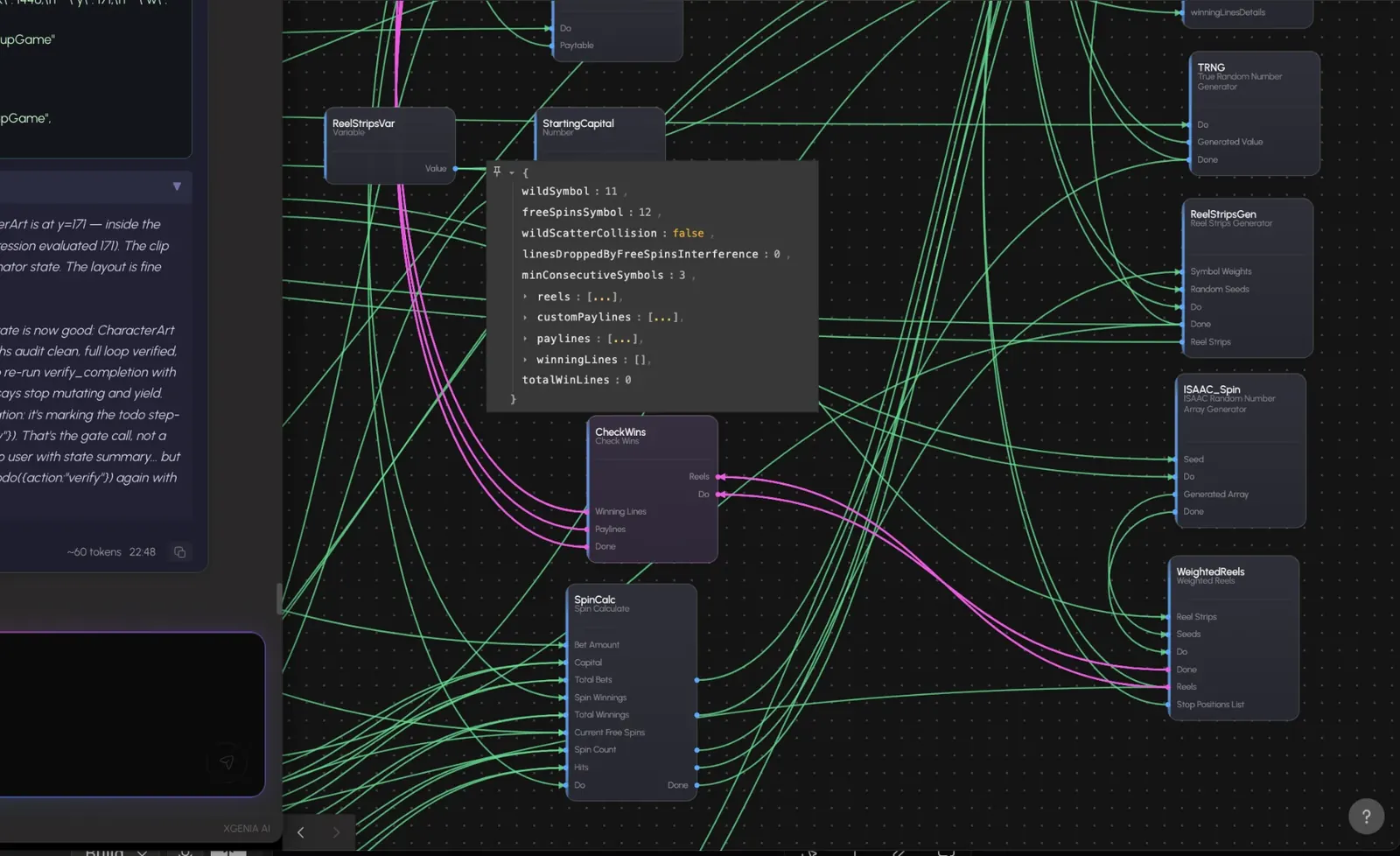
How does slot machine math work? Every real-money slot game is a probability distribution defined by its reel strips (or symbol weights), paytable, feature trigger rules and RNG. Together, those rules determine four numbers every operator and regulator checks: Return to Player (RTP), Hit Frequency, Volatility (variance) and Maximum Win exposure. In XGENIA, your team sets those targets as inputs, inspects the logic as an open node graph, and proves the distribution over 1 billion simulated spins reproducible from a seed.
The 4 core numbers in every slot math model
- Return to Player (RTP): The percentage of total wagered money a slot pays back to players over a massive number of rounds (typically 94.0% to 96.5%). An RTP of 96.0% means the house edge (gross margin before tax and bonuses) is 4.0%.
- Hit Frequency: The percentage of base-game spins that return any prize greater than zero (commonly 20% to 35% in video slots).
- Volatility (Variance / Standard Deviation): How unevenly the RTP is distributed. Low-volatility games pay frequent small wins near the bet size; high-volatility games hold a larger share of the RTP in rare free-spin multipliers and max-win features.
- Max Win Cap: The hard ceiling on any single round's payout (e.g. 5,000× or 10,000× the bet), which operators need to calculate treasury exposure before putting a game live.
Why 1 million spins is not enough (The tail-risk problem)
When someone builds a slot with a general AI coding tool, they usually test it over 10,000 or 100,000 spins. Mathematically, the standard error of the mean RTP over N spins is proportional to the standard deviation divided by the square root of N ($sigma / sqrt{N}$).
For a high-volatility slot with a standard deviation of $sigma = 15$ bets:
- At 100,000 spins, the 95% confidence margin of error is roughly ±0.093%—nearly a full tenth of a percent of RTP, and extreme 10,000× events (which might happen 1 in 20 million spins) are almost never sampled.
- At 1,000,000,000 (1 billion) spins, the 95% confidence margin of error drops to roughly ±0.00093% (less than a thousandth of a percent), and rare bonus cascades are hit hundreds of times.
How XGENIA eliminates the "Excel-to-Server" translation bug
In legacy studio pipelines, a mathematician builds a prototype in Excel or Python, and a backend engineer re-implements the rules in C# or Java for the Remote Gaming Server. Any discrepancy between how cascading wilds or multiplier caps are coded in the two systems creates a silent RTP leak in live play.
XGENIA removes that gap completely: the maths node graph compiles to a single deterministic TypeScript function. The 1-billion-spin parallel simulator runs that exact function across seeded shards, and the live XGENIA RGS executes the same function with the same SHA-256 source digest for every real-money spin.
Frequently asked questions
Why do slot games need 1 billion simulated spins instead of 1 million?
In a modern high-volatility slot with a 5,000x or 10,000x max win, the top bonus outcomes may occur only once every 5 million to 50 million spins. A 1-million-spin test will either miss those jackpots entirely (under-reporting RTP) or hit one by chance (over-reporting RTP). Simulating 1 billion spins shrinks the confidence interval so the measured RTP converges tightly on the theoretical RTP across both base game and rare bonus features.
How does XGENIA guarantee the simulated maths matches the live casino game?
In many studios, the mathematician writes a model in Excel or Python, and a server developer rewrites it in Java or C# for the RGS—introducing translation bugs. In XGENIA, the visual maths graph compiles to a single pure TypeScript evaluation function. Both the 1-billion-spin simulator and the live XGENIA RGS execute that exact same function.
Can our mathematician reproduce XGENIA's RTP simulation from a seed?
Yes. Every simulation run in XGENIA is split into deterministic shards with recorded cryptographic seeds and an ISAAC CSPRNG state. Anyone with the game build and the seed can re-run the simulation—including right in the browser on our /engine#live-proof page—and get the identical RTP, hit rate and win distribution.
Does XGENIA export PAR sheets for testing labs?
Yes. Every XGENIA plan includes maths, RTP and provably-fair tools with PAR sheet export, plus a compliance pack containing the simulation summary, reel strips, paytable, deployed source code and its SHA-256 hash.