2026-11-07 · AI Game Harness · XGENIA
Why Most AI Slot Games Are Slop (And How an AI Game Harness Fixes It)
A prompt-only workflow makes a game that looks right at first glance. An AI game harness enforces style anchors, real artist brushes, open TypeScript and 1-billion-spin maths checks so your team ships studio polish.
Key Takeaways
- AI slop happens when a tool chains raw LLM and image prompts together without verification gates, style anchoring or human hand-off tools.
- An AI workflow generates a black-box output you can only fix by re-prompting; an AI harness checks every step and hands artists and engineers real editing tools.
- XGENIA prevents visual slop by locking your approved key art as a style anchor and giving artists 8 brush families, wet-paint surface physics and Wacom pen pressure/tilt inside the engine.
- XGENIA prevents technical and maths slop by compiling mechanics into an open 303-node PixiJS v8 TypeScript graph, simulating RTP over 1 billion spins, and testing the live game in a headless browser before publishing.
Why do most AI-generated slot games look like "AI slop"? Because anyone can wire an LLM to an image generator over a weekend and call it an AI game builder. When a tool relies on raw prompting alone, symbols clash in style, fingers and coins melt on close inspection, reel animations stutter, and the underlying RTP maths is an unverified guess. Players spot it in three seconds, and casino directors reject it on the spot.
The problem is not AI. The problem is AI without a harness.
What is the difference between an AI workflow and an AI game harness?
A workflow is a one-way pipe: prompt in, asset out. When the AI gets 85% of a slot right and 15% wrong—which is what raw models always do—a workflow forces you to keep re-rolling the prompt and hoping the model fixes the mistake without breaking the rest of the screen.
An AI game harness (like XGENIA) treats AI as the fast first draft and puts deterministic software checks and professional human craft tools around every single step:
- Style anchoring instead of random image prompts: One approved key-art image governs the palette, lighting and line weight of every symbol, background and UI frame in the project.
- Direct human hand-off instead of prompt roulette: Artists paint over layers with physical brushes; mathematicians adjust reel weights and paytables; engineers edit TypeScript nodes.
- Automated self-testing instead of "looks good to me": The engine boots the game in a headless browser, clicks spin, checks that the bet deducts, verifies zero console errors, and blocks deployment until the maths is simulated.
How XGENIA ends visual slop: Style anchors, 200+ models and wet paint
In a studio slot, the difference between an amateur game and a top-grossing title is art direction. XGENIA gives art directors and illustrators three layers of control:
- The Project Style Anchor: The first step of every XGENIA build is creating and approving the key art. Once your art director approves it, XGENIA locks it as the style anchor—every high-pay symbol, low-pay royal, scatter, wild and reel frame is generated as a controlled variation of that anchor.
- The Model Hub (217+ models): Instead of locking you into one fine-tuned checkpoint, XGENIA's Model Hub lets your team pick the best model for each craft—Image to Image, Text to Image, Inpainting, Image to Video, Audio & Speech, 3D (such as Meshy 6), vectorisation, background removal and crisp upscaling via fal and OpenRouter.
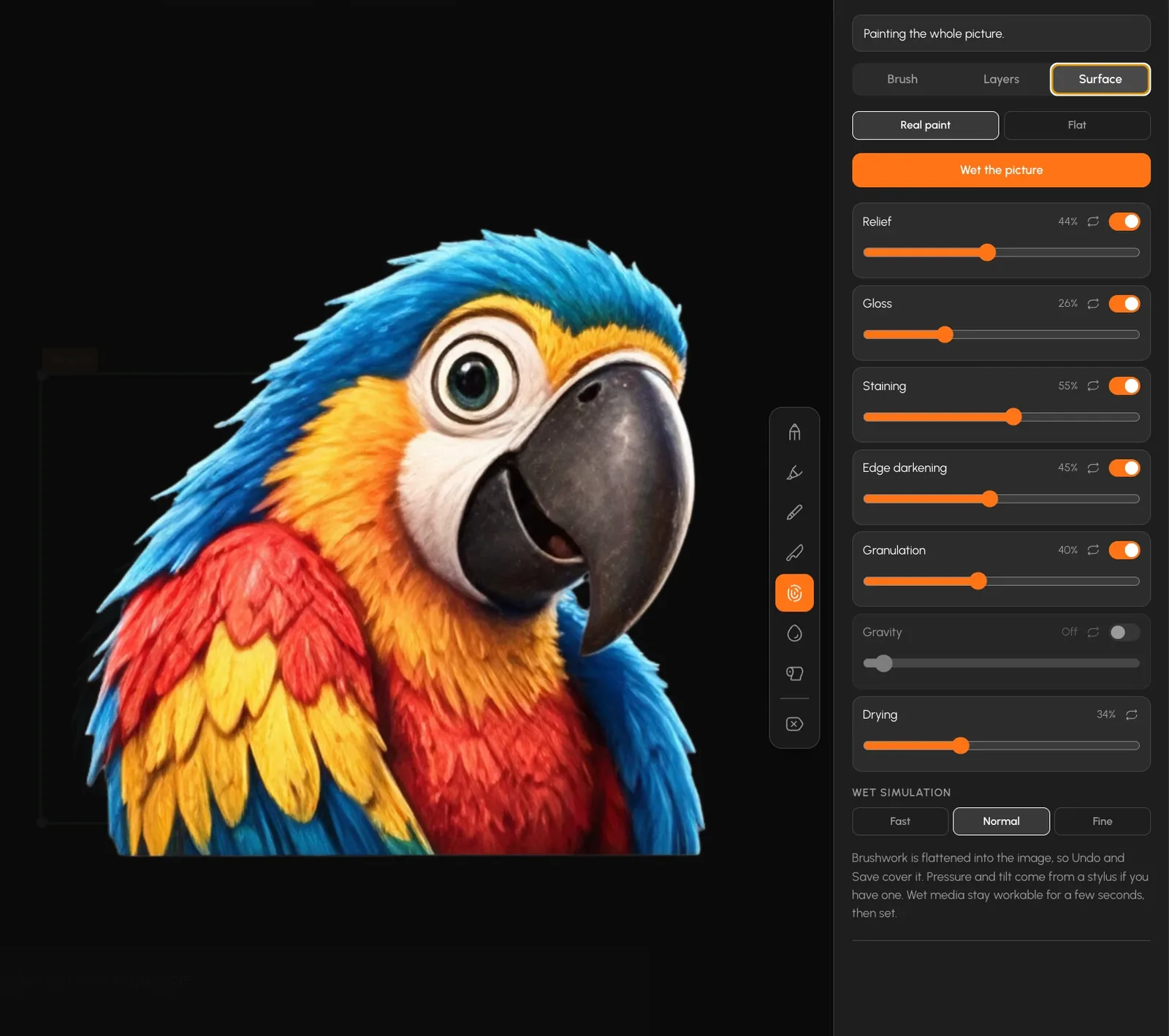
- Built-in Layer Editor & Wet Paint Surface: Every generated image opens in XGENIA's layer editor. Artists have eight brush families (Sketching, Inking, Drawing, Painting, Watercolour, Charcoal, Airbrushing and Texture) and a real-paint Surface engine with sliders for Relief, Gloss, Staining, Edge darkening, Granulation and Drying, plus full Wacom stylus pressure and tilt support.
How XGENIA ends code and maths slop: Open nodes and self-testing
Even a beautiful slot fails if the maths bleeds margin or a bonus round freezes on mobile Safari. XGENIA eliminates black-box code slop with three mechanisms:
- 303 readable nodes on a PixiJS v8 canvas: Every mechanic is wired visually on the canvas, and clicking any node opens the clean, typed TypeScript behind it. There is no proprietary scripting language and no hidden runtime.
- Self-verifying AI chat: When you ask XGENIA AI to build or publish a game, the assistant does not just write code and stop. It runs the maths simulation, publishes the preview build, opens the live game, presses Spin to verify that credit deducts and wins settle cleanly with zero errors, and clearly states what was measured.
- Human sign-off gates: The AI cannot change your game's odds without your explicit confirmation, and it can never push a game to real-money play. A human on your team approves every versioned release.
Frequently asked questions
What is an AI game harness and how is it different from an AI workflow?
An AI workflow simply passes your prompt to an image generator and a code model and hopes the output works. An AI game harness wraps the AI inside strict engineering, art and compliance guardrails: every generated asset is anchored to your approved key art, every mechanic is a readable node with editable TypeScript, the maths cannot ship until it passes a 1-billion-spin simulation, and the engine tests the running game itself before handing control to your team.
How does XGENIA stop AI slot art from looking generic or inconsistent?
First, your team approves the game's key art, which XGENIA locks in as the project style anchor—every symbol, background, character and button is generated as a variation of that approved image. Second, artists never have to fight a prompt box to fix a detail: they open the asset directly in XGENIA's layer editor and paint by hand with 8 brush families, wet-paint physics (relief, gloss, staining, granulation, drying) and stylus pressure and tilt.
Can developers edit the code generated by XGENIA's AI?
Yes. Nothing in XGENIA is a black box. Every reel spin, win evaluation, animation trigger and UI screen sits on a visual node canvas of 303 node types, and engineers can open the clean TypeScript and PixiJS v8 code behind any node, diff it in GitHub, or drive it from Claude Code.
Can XGENIA's AI change game odds or publish to real money on its own?
No. The harness enforces hard gates: the AI cannot alter a game's RTP or paytable without your team's approval, cannot mark a build complete until automated verification passes, and cannot put a game live for real money. A human on your team signs off every live release in the RGS dashboard.